
Happy Lesbian Visibility Week, Sci Fi and Fantasy Readers!
What does "lesbian visibility" mean in fantasy novels?

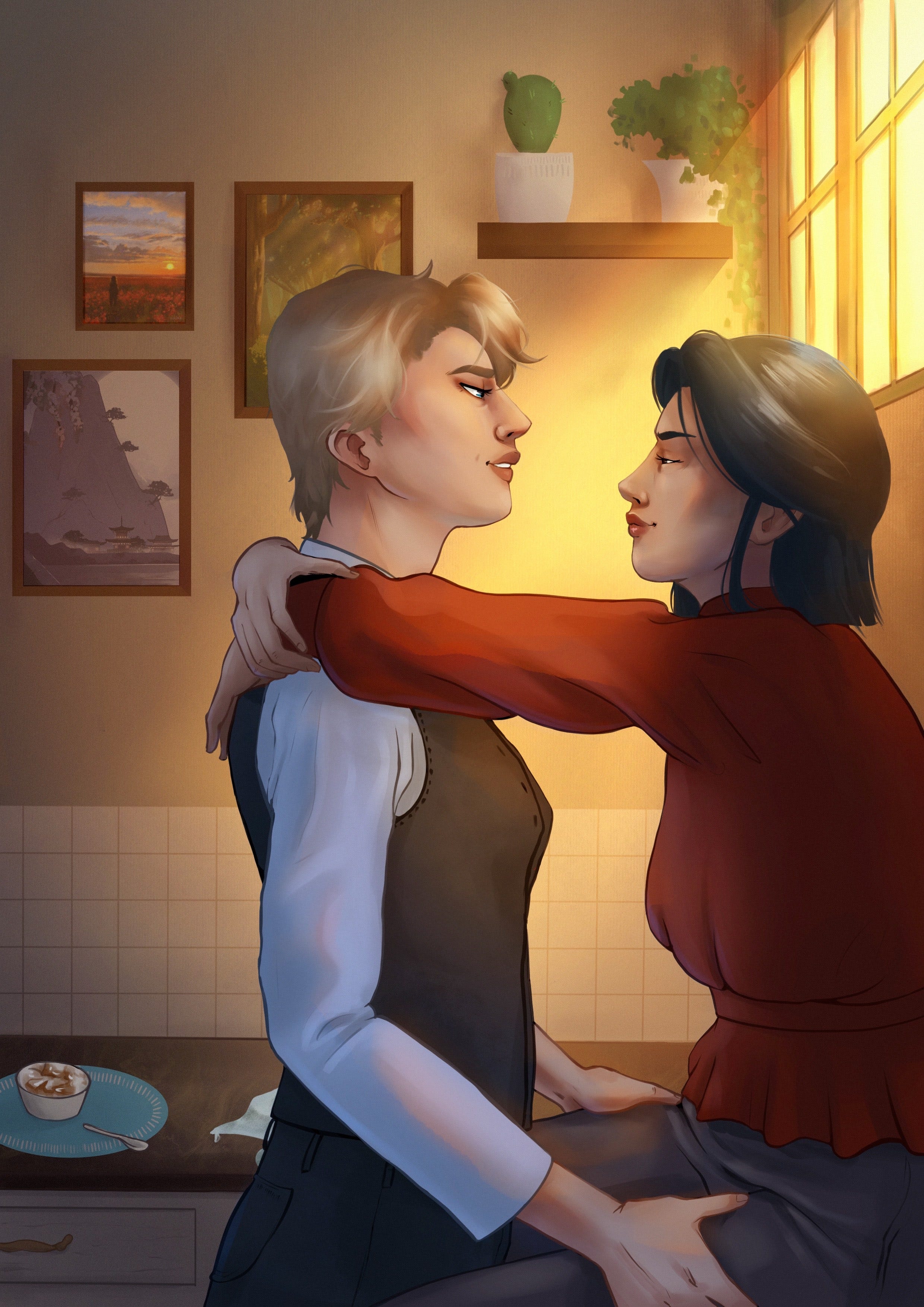
Hi everyone! Did you know that April 20-26 is Lesbian Visibility Week? I honestly did not know this until social media informed me, and I am somewhat annoyed that I couldn’t prepare better with a haircut or something. We had a lesbians-with-kid family trip to the beautiful, surreal world of Joshua Tree National Park, where it rained in the desert, and we saw a rainbow and I was able to see the stars in a way I’ve missed since a trip to New Mexico years ago. We saw a shooting star, too, our little family sitting in a hot tub under the night sky, and we all made secret wishes that we did not tell one another.
My fictional lesbians Aili and Chenguang, who are still dealing with their past-life issues in The Seaglass Blade, are very much on my mind at the moment. I’m working on a final copyedit for Seaglass and I’ve set a date for release: June 1, for Pride month! (You can preorder now if you’d like to plan ahead!) Seaglass is intended to work as a standalone in the Crane Moon Cycle world, but for those who want to read the duology first (The Phoenix and the Sword and The Shoreless River), The Phoenix and the Sword will be on sale for .99 on all platforms through the end of May.
So back to this lesbian visibility thing…it’s interesting as a fantasy author to try to think about how “lesbian” works in a fantasy setting. (And to be very clear, “lesbian” does include people who challenge the gender binary in all kinds of ways.) In second-world fantasy, gender and sexuality categories could be different, as they are in different cultures and time periods in history. Women whose desire is only for other women might not have had a name for what they were and who they loved, or that name might have been quite different, with different connotations and understandings of what it meant.
I am comfortable calling Aili and Chenguang lesbians, since even though their world is a fantasy world and not identical to our own, the inspiration for the setting where they met one another is the 1940s United States. Aili would call herself a butch lesbian if anyone asked; Chenguang would roll her eyes and say it’s not your business, but mostly because she wouldn’t want to discuss the nature of phoenixes with random strangers.
It’s sometimes very clear that characters in other fantasy and science-fiction settings would be called “lesbian” in my own, real-life culture, even if they don’t use the word. There’s an exchange I love in Hiyodori’s novel Three Murdered Mages, Two Broken Bonds where the main character, Clem, is talking with her partner Wist and playing mental matchmaker for some of their friends.
“You never think of pairing men and women romantically, do you?” Wist asked.
To anyone else she would have sounded unimpressed. To my ear, she sounded amused.
”My brain doesn’t work that way,” I said. “I’ll leave that stuff to the experts.”
I love Clem and Wist and all of Hiyodori’s novels, which are all set in the same magical world. And it’s a perfect example of how a second-world fantasy can delineate an identity, with its worldview and cultural structure and priorities of perception, without using a specific term. None of the characters, including Clem and Wist, have named themselves with a sexual orientation (magical identity categories are much more central in their world), but Clem experiences life as someone who simply does not perceive romantic possibilities except queer ones.
Many sapphic and queer fantasy novels are “queernorm,” in that they take place in a world where no one cares about the genders of who is involved in a sexual or romantic relationship. In a rough way, in queernorm fantasy worlds it’s still possible to sometimes notice that certain characters are only attracted to a subset of possibilities—gay or lesbian in my own cultural terms—while others are interested in a wider subset, but it’s not usually part of the story. Imagining a queernorm world means that certain aspects of being queer may not be visible, including the risks that people take to find one another and be together, the subcultures and identities that are created and the community values that develop, and the ways that it requires resistance and courage simply to exist.
One of the most interesting examples of lesbian identities in fantasy that I’ve read recently is Metal from Heaven, by August Clarke. This book is ecstatic and intense and I’ve not stopped thinking about it since finishing it last year. The worldbuilding is amazingly detailed, and one of its strengths is that it’s highly pluralistic and pays attention to class as well as national distinctions. The story touches on lesbian and other queer identities that have real historical roots, showing how there are differences even within the same culture in how social and educational classes perceive lesbian identities, how people act differently in specific contexts. The internal experience of desire and love might have some universal aspects, but the ways in which we think, speak, act, and live out that internal experience is heavily structured by the linguistic, cultural, and political worlds in which we live.
With all that, I’m glad to be lesbian, and grateful to live in a place that is relatively safe to be visible as part of a lesbian couple with my family, and will fight for our rights to continue to be visible and to be safe. I am very aware that this safety doesn’t exist for all lesbians, and that’s why, for me, it’s important to have examples of our relationships in literature. And I’m grateful for you as a reader: whether you identify as part of the queer community or not, your support is important to every queer author.
If you have a favorite sapphic fantasy or sci-fi novel with lesbian characters, or by a lesbian author, I’d love to know it! you can celebrate them in the comments :)
WisCon
Did you know there’s a feminist science fiction and fantasy conference that’s been running since 1977, and this year will be fully online, May 21-25? It’s called WisCon! Want to attend? I’m planning to be there! This year’s Guests of Honor will be Premee Mohamed and Darcie Little Badger. Learn more and register here!
Kobo Plus Fantasy
Kobo is a book marketplace, like Amazon, with its own e-reader and free reading app, and it also has a subscription service, Kobo Plus: one monthly price for unlimited reading! If you’d like to explore Kobo Plus, here’s a gathering of some of the fantasy books available there.
Fantasy with Mythical Creatures
There’s also a selection of books featuring mythical creatures to explore here!